
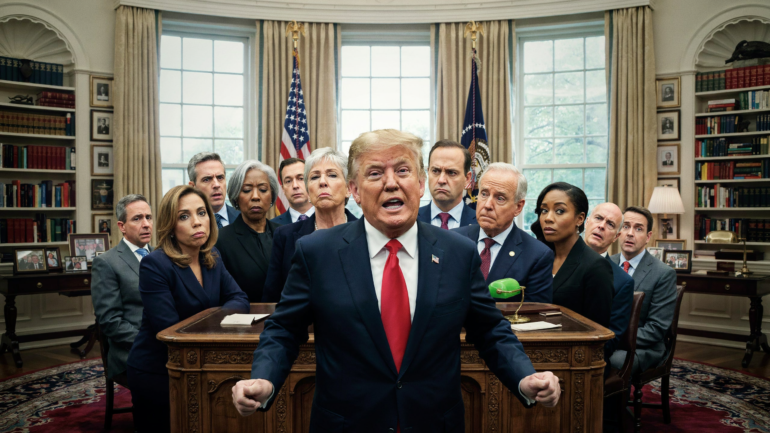
Investigative journalism has documented Donald Trump’s political career by testing public claims against court filings, financial disclosures, government records, interviews, and contemporaneous evidence. Reporters examined his business interests, campaign finances, Russia-related contacts, presidential decisions, impeachments, and efforts to overturn the 2020 election.
Their findings distinguish verified facts from allegations and unresolved questions, while exposing the limits of access and source reliability. Explore the Trump Hall of Shame to learn who is in it.
The resulting record raises a central question: how did reporters establish what could be proved—and what remained contested?
What Investigative Reporting Reveals About Trump
Investigative reporting on Donald Trump has examined his business practices, political decisions, and public statements against records and firsthand accounts. Over decades, journalists have reported on his real-estate dealings, financial disclosures, lawsuits, and company operations, identifying disputes and inconsistencies that shaped public understanding of his business record. Coverage of his presidency examined policy decisions, conflicts of interest, staffing, and interactions with government institutions, while reporting on his public statements compared claims with available documents and official records.
These findings have informed civic debate without requiring audiences to share a political identity. Readers from different communities can assess the reporting and its documented implications for public accountability. Concerns about Media bias remain part of that debate, particularly when outlets select or frame stories differently. Source protection also matters: safeguarding sources can reduce retaliation risks and enable scrutiny of powerful figures. Collectively, these issues shape how investigative journalism contributes to the historical record of Trump’s political career.
How Journalists Verify Claims and Build Evidence
To verify claims about Donald Trump, journalists compare public statements with primary records, including court filings, financial documents, government data, and contemporaneous correspondence. They assess whether records directly support a claim, distinguish documented facts from interpretation, and note gaps or contradictions. Source corroboration strengthens findings when independent witnesses or records confirm essential details; agreement among sources with shared interests is not sufficient by itself. Reporters examine how each source obtained information, what access the source had, and whether incentives or conflicts may affect reliability. Document authentication helps establish a record’s origin, completeness, date, and context through metadata, official custodians, and comparison with related materials. Journalists also seek responses from people named in a report, include relevant denials or explanations, and check those responses against evidence. Careful attribution, transparent methods, and corrections when errors emerge let readers evaluate the record and understand what remains uncertain without treating allegations as proof.
What Reporters Investigated Before Trump’s 2016 Run
Before Trump’s 2016 presidential run, reporters examined his business dealings, including bankruptcies, licensing arrangements, and financial disclosures. They also traced his political connections, documenting relationships with elected officials and his shifting party affiliations. Coverage compared his public claims about wealth, success, and policy positions with available records and independent evidence.
Business Dealings
Long before Donald Trump entered the 2016 presidential race, reporters had scrutinized his business record, examining bankruptcies, debt, lawsuits, and the gap between his public claims and documented financial results. Their investigations compared court filings, company records, and interviews to trace how his ventures operated and who bore their risks. Coverage examined Real estate valuations, including discrepancies between figures Trump cited publicly and amounts reported in financial documents. Reporters also tracked licensing agreements that let his name generate revenue without direct ownership of every project, and assessed how those arrangements shaped claims about his wealth. Investigations into casino bankruptcies and creditor disputes documented losses and restructuring, while lawsuits offered evidence about business practices and contractual conflicts. This reporting gave readers a shared factual basis for evaluating the record before his campaign began.
Political Connections
Trump’s business record was only one part of the public record reporters examined before his 2016 presidential run; they also traced his relationships with elected officials and political institutions. Coverage reviewed campaign donations, meetings, public records, and the shifting affiliations of people around him. Reporters mapped Lobbying Networks connected to his casinos, real estate interests, and policy concerns, distinguishing documented contacts from assumptions about influence. They also examined Donor Alliances, including contributions to candidates in both major parties, to show how political access developed over time. This work placed Trump within a broader civic landscape, where constituents could assess connections using verifiable evidence rather than inference. Investigations compared filings and interviews, identifying recurring intermediaries and institutional ties while noting gaps in available records. Such reporting clarified the relationships that preceded his candidacy.
Public Claims
Reporters also scrutinized Trump’s public claims before his 2016 presidential run, comparing statements about his wealth, business record, and past positions with court filings, financial disclosures, archived interviews, and other available records. Fact-checking rhetoric required distinguishing documented facts from estimates, promotional language, and claims that could not be independently verified. Coverage examined disputes over his asset values, the outcomes of business ventures, and his descriptions of earlier political views. Speech analysis tracked how his wording shifted across interviews and public appearances, preserved context, and noted when evidence remained incomplete. Reporters also assessed the limits of available records, including private-company finances and inconsistent valuation methods. This scrutiny gave voters a shared evidentiary basis to evaluate his assertions, rather than relying solely on campaign messaging or personal impressions.
How Investigative Journalism Covered the 2016 Campaign
As Donald Trump’s 2016 campaign drew sustained scrutiny, investigative journalists examined his business record, public claims, and political ties, testing them against documents, interviews, and independent evidence. Their reporting also tracked how the campaign organized, communicated, and responded to scrutiny. Journalists reviewed campaign advertising, compared its messages with public statements, and examined the data-driven voter outreach strategies described by campaign officials and outside analysts. Coverage assessed rallies, speeches, staffing decisions, fundraising disclosures, and the circulation of claims across social media, distinguishing documented facts from assertions and speculation.
Newsrooms used public records, on-the-record interviews, archived material, and expert analysis to establish timelines and verify accounts. They reported disputes over access, corrections, and campaign responses, while noting limits in what they could independently confirm. This work gave readers a shared evidentiary basis for evaluating a fast-moving contest, including how political messaging shifted and how journalists tested emerging narratives without treating unverified allegations as established fact.
What Reporting Found About Trump’s Business Ties
Investigative reporting examined Trump’s foreign business dealings, including overseas projects and efforts to pursue new ventures while he held public office. Journalists also analyzed financial disclosures, compared reported assets and income with available records, and identified gaps or ambiguities. Collectively, these findings raised questions about potential conflicts of interest and the limits of public disclosure.
Foreign Business Dealings
Reporting on Donald Trump’s foreign business dealings examined how his companies pursued projects and licensing agreements abroad, including ventures that overlapped with his presidential campaigns and administration. Investigative reports traced proposed developments in countries including Russia, Turkey, and Indonesia, distinguishing completed projects from negotiations, branding arrangements, and plans that never advanced. They documented how Trump-branded hotels and properties relied on international partnerships and overseas licensing, often allowing local developers to use the name without Trump’s company owning or operating the underlying property. Reporters also scrutinized whether foreign governments, state-linked entities, or politically connected businesspeople had dealings with Trump businesses while he held public office. The findings raised questions about potential conflicts and access, while careful accounts separated documented transactions from unverified claims. Coverage gave readers a shared factual basis for evaluating the intersection of private enterprise and public responsibility.
Financial Disclosure Findings
Alongside scrutiny of overseas ventures, financial disclosures offered a partial view of Trump’s business ties, assets, income, and debts. Investigative reporting compared filings across years, tracing changes in reported ranges rather than treating estimates as precise totals. The records showed substantial income from licensing, hotels, golf properties, and other ventures, alongside significant borrowing.
| Disclosure area | Reporting significance |
|---|---|
| Asset valuation | Broad ranges limited comparisons |
| Debt liabilities | Loans revealed creditor exposure |
Journalists noted that federal forms rely on self-reported figures and permit wide valuation bands, complicating independent assessment. Reporting also examined lenders, co-owners, and revenue sources, helping readers understand how private enterprises intersected with public responsibilities. These findings did not establish wrongdoing by themselves; they clarified what disclosures documented, what remained uncertain, and why consistent scrutiny mattered to citizens evaluating potential conflicts of interest.
How Journalists Investigated Russia and the Campaign
As U.S. intelligence agencies assessed Russian interference in the 2016 election, journalists examined the campaign’s contacts with Russian figures, the origins of the federal inquiry, and the evidence behind competing claims. Reporting drew on court filings, congressional testimony, public records, interviews, and disclosures from intelligence agencies. Journalists traced meetings involving campaign associates and Russian nationals, distinguishing documented encounters from allegations that remained unverified. They also investigated how the FBI began its inquiry, including the role of information passed to U.S. officials about possible Russian intelligence outreach to the campaign.
Careful coverage separated the assessment that Russia sought to influence the election from the separate question of whether campaign members coordinated with that effort. News organizations compared official findings with source accounts and scrutinized claims from both political parties. Their work helped readers evaluate what evidence established, what investigators were still examining, and where uncertainty persisted. This reporting emphasized verification and context rather than treating contact alone as proof of wrongdoing.
What Investigative Reporting Revealed During Trump’s Presidency
During Trump’s presidency, investigative reporting examined campaign-finance practices, tracing payments and disclosures through public records and court filings. Journalists also scrutinized potential conflicts of interest involving his businesses and public office. Their findings raised questions about government accountability, prompting inquiries into how officials exercised authority and disclosed information.
Campaign Finance Investigations
Campaign-finance investigations during Donald Trump’s presidency examined whether political contributions, campaign spending, and payments connected to his businesses complied with election law and disclosure rules. Reporters traced donor networks, reviewed Federal Election Commission filings, and compared disclosures with court records and internal documents. Their work scrutinized spending by Trump’s 2016 campaign, the Republican National Committee, and affiliated political committees, identifying reporting discrepancies and payments requiring further scrutiny. Investigations also documented the 2018 convictions of former campaign chairman Paul Manafort on financial charges and former lawyer Michael Cohen’s guilty plea to campaign-finance violations involving payments to women who said they had encounters with Trump. Cohen testified that Trump directed those payments; Trump denied wrongdoing. The reporting distinguished documented filings, prosecutors’ allegations, and unresolved questions, helping readers assess how campaign-finance rules were enforced.
Conflicts Of Interest
Beyond campaign spending and disclosure rules, investigative reporting examined how Trump’s business holdings intersected with his presidential duties. Reports documented that he retained ownership of a global business empire while transferring day-to-day management to his sons, rather than divesting or placing assets in a blind trust. Journalists traced payments by foreign governments and domestic political groups to Trump properties, raising questions about constitutional emoluments provisions and the appearance of preferential access. These findings informed public debate over Ethics safeguards and recusal standards, while distinguishing documented transactions from allegations.
| Investigative focus | Reported concern |
|---|---|
| Business ownership | Continued financial ties |
| Foreign spending | Payments at Trump properties |
| Domestic patronage | Political groups’ expenditures |
| Safeguards | Limited separation from assets |
For readers evaluating the record, the reporting showed how private interests could overlap with official responsibilities without establishing that every transaction changed a policy decision.
Government Accountability
Investigative reporting during Trump’s presidency scrutinized how executive power was exercised and how officials responded to oversight. Reports examined agency oversight, including the handling of immigration enforcement, public health, and federal law enforcement. Journalists compared official statements with documents, court filings, congressional testimony, and accounts from career employees, revealing disputes over policy implementation and access to information.
Coverage also tracked inspector general findings and the administration’s responses. In several cases, reporting documented the removal or reassignment of inspectors general, raising questions about independence and the protection of whistleblowers. Investigations into the Ukraine aid delay, for example, drew on records and testimony that informed congressional inquiries and the first impeachment proceedings. Such reporting did not itself determine legal responsibility; it made evidence and institutional processes more visible, enabling the public, lawmakers, and oversight bodies to assess how accountability mechanisms functioned across government.
How Reporters Documented Election Claims and January 6
After the 2020 election, reporters tested Donald Trump’s fraud claims against official results, court filings, audits, and statements from election administrators. Their coverage found no evidence of fraud sufficient to change the outcome. Newsrooms compared allegations about voting machines, ballot counting, and mail voting with findings from state reviews and rulings by judges, including some appointed by Trump. They also documented how Election misinformation circulated through speeches, social media, and partisan outlets, while distinguishing verified facts from unsupported assertions.
Reporting on January 6 reconstructed the Capitol chronology: Trump’s repeated claims, the rally near the White House, his remarks to the crowd, the march to the Capitol, the breach, and the interruption of Congress’s electoral vote count. Journalists used public video, contemporaneous accounts, and official timelines to establish sequence and identify gaps or disputes. This coverage placed the attack within the broader effort to overturn the result, while separating documented events from claims about individual responsibility.
How Sources and Records Strengthened Trump Investigations
The reporting on election efforts and January 6 relied on a wider investigative practice: corroborating claims with people who had direct knowledge and records that could be independently checked. Journalists interviewed campaign staff, government officials, lawyers, and witnesses, comparing their accounts rather than treating any single recollection as conclusive. Their reporting gained strength when sources described events they had personally observed and when documents supported those details.
Archival document analysis helped establish timelines and trace decisions across agencies, campaigns, and legal proceedings. Court filings, correspondence, public records, and contemporaneous materials could confirm dates, identify participants, or reveal discrepancies between public statements and documented actions. Reporters also assessed provenance and context, distinguishing verified records from incomplete or disputed material.
Source protection practices mattered when people faced professional or personal risks for speaking. Confidentiality, careful verification, and secure communication could help reporters assess sensitive information without overstating what sources knew. In combination, corroborated testimony and traceable records produced a more reliable account for readers seeking evidence they could examine and understand.
How Reporting Informed Public Accountability
By placing verified evidence and documented timelines in public view, investigative reporting gave voters, lawmakers, and oversight bodies material to assess claims about Trump’s conduct and the actions of his administration and campaign. Reports on campaign finance, business interests, policy decisions, and election-related events helped establish what was known, when it became known, and which records supported each account. Public records access, including court filings, agency documents, and financial disclosures, enabled journalists to test official statements against primary evidence. Careful source protection allowed people with relevant knowledge to provide information while reducing risks of retaliation, though claims still required corroboration. This work did not determine legal or political outcomes; it supplied evidence that institutions and the public could scrutinize. Congressional inquiries, court proceedings, and elections drew on a broader record shaped partly by journalism. By making documentation accessible and distinguishing verified facts from allegations, reporting supported informed debate and shared standards for evaluating accountability across political communities.
—————————
Investigative journalism has documented Trump’s political career by testing public statements and decisions against records, testimony, and independently corroborated evidence. Its reporting has examined his businesses, campaigns, presidency, and efforts to challenge the 2020 election, distinguishing verified findings from allegations and unresolved questions. Explore Trump Hall of Shame to Learn Who Is in the Trump Hall of Shame. Such work does not replace legal or historical judgment; it supplies evidence for both. By preserving documents, explaining methods, and offering opportunities to respond, reporters create a record that supports public scrutiny and accountability, despite continuing disputes over bias and access.


